Parsons Journal for Information Mapping: A Quarterly Publication on Knowledge Visualization Theory and Practice

SUBSCRIBE ONLINE   |   SUBMIT YOUR MATERIALS

ABOUT PJIM  |  ISSUES  |  POLICIES  |  YOUR SUBSCRIPTION  |  CONTACT US

Volume I, Issue 4

This issue of PJIM closes out our first full year of publication, and along with that milestone, four great works. Two essays in this issue discuss visualization of "spaces". One work focuses on physical (e.g. a museum building) and another on imaginary (e.g. imagination scenarios) space. Each work delves into the concepts and methods of representing these different spaces in a similar manner — in these cases, via representational and descriptive objects of the original space.

Our other two essays discuss the elements of visual imagery and their effects on very expansive and globally-focused communities. One work speaks of the different social and cultural progression in two distinct religions as a result of cultural imagery. The other work discusses how a vast network of geographic imagery and information has defined communities and our global (or local) perception of them. Together these works exemplify the power of visualization and imagery and how important and powerful they are on our perceptions of communities and our involvement in those communities.

As we close out this first successful year of publication I speak for everyone at PJIM and thank our contributors and supporters for their effort and look towards many future years of collaboration.

— Brian Willison, Publisher, Parsons Journal for Information Mapping
Imagining Possible Futures with a Scenario Space

David Staley, PhD

The 9/11 Commission reported that the failure to anticipate and prevent the events of September 11th was much a "failure of the imagination" as anything else. "It is therefore crucial," concluded the Commission, "to find a way of routinizing, even bureaucratizing the exercise of imagination." However, "bureaucratizing the exercise of imagination" is not an easy task, because those of an analytic bent find the exercise of imagination seems too subjective and imprecise to be useful, and those who are...

Read entire abstract | Read author's biography | Read project metadata

Download Essay PDF (8pgs, 236kb) Opens link in new window

Abstract

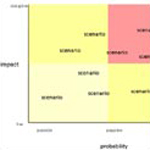
The 9/11 Commission reported that the failure to anticipate and prevent the events of September 11th was much a "failure of the imagination" as anything else. "It is therefore crucial," concluded the Commission, "to find a way of routinizing, even bureaucratizing the exercise of imagination." However, "bureaucratizing the exercise of imagination" is not an easy task, because those of an analytic bent find the exercise of imagination seems too subjective and imprecise to be useful, and those who are imaginative chafe at the idea of making this most creative of abilities routine and bureaucratic. Those engaged in strategic foresight, especially, face this twin problem when it comes to imagination: they must develop the skill to imagine wild card, outlier and other 9/11 -type scenarios, but must also manage and organize the potentially limitless number of such scenarios in manner as to make them intelligible and actionable. This article details a type of configuration space called a "scenario space," which helps those engaged in futuring and foresight processes to encourage and manage imagination. A scenario space is designed 1) to organize the imagination 2) to act as a diagnostic tool as to an organization's imaginative capacity and 3) to encourage imaginative thought and peripheral visioning.

Close this window

Biography

David J. Staley, Ph.D. is principal of The DStaley Group, a strategic futuring consulting firm. He is the author of Computers, Visualization and History (2003) and History and Future: Using Historical Thinking to Imagine the Future (2007). A "humanities-based imagist," Staley has also designed exhibitions, installations and other information visualizations.

Close this window

Project Metadata

Project Title: Imagining Possible Futures with a Scenario Space

Keywords: futuring, scenarios, imagination, configuration space, thought leadership, foresight, peripheral visioning

Close this window

Spatial Awareness and Exploration of the Museum Building

Marcos Pereira Dias, MSc.

We are the collective CUBE (Creative Union Building Explorers), a subgroup of the final project of the MSc Interactive Digital Media 2008/2009 course in Trinity College, Dublin, Ireland. The project's aim was to tell the story of the Museum Building inside the Trinity campus through an interactive website. CUBE's aim was to explore the Museum Building as an entity brought to life through its interactions with people. We researched the spatial environment of the building by recording and manipulating images...

Read entire abstract | Read author's biography | Read project metadata

View Spatial Awareness and Exploration of the Museum Building online Opens link in new window

Download Essay PDF (8pgs, 226kb) Opens link in new window

Abstract

We are the collective CUBE (Creative Union Building Explorers), a subgroup of the final project of the MSc Interactive Digital Media 2008/2009 course in Trinity College, Dublin, Ireland. The project's aim was to tell the story of the Museum Building inside the Trinity campus through an interactive website. CUBE's aim was to explore the Museum Building as an entity brought to life through its interactions with people. We researched the spatial environment of the building by recording and manipulating images and sounds, analyzing patterns of circulation inside and around the Museum Building and investigation the experiences of individuals. The research and recording process was used to develop a unique and discoverable interface, which tells the story of the building through its rich spatial, visual and audio content rather than through a standard descriptive and informational narrative.

Close this window

Biography

Marcos Dias is a digital media designer interested in the facilitation of social interaction through digital narratives in physical spaces. He studied Architecture in the University of Sao Paulo, Brazil and has recently been awarded an MSc with Distinction in Interactive Digital Media from Trinity College Dublin, Ireland. He is presently participating in the Designing Dublin project, a multidisciplinary initiative run by Design Twentyfirst Century (http://www.design21c.com) in partnership with the Dublin and Fingal City Councils. His work is documented at http://www.lightartworks.com.

Close this window

Project Metadata

Project Title: Spatial Awareness and Exploration of the Museum Building

Keywords: Spatial awareness, urban exploration, psychogeography, interactive narrative, soundscape, circulation mapping, light manipulation, social interaction

URL: http://www.museumbuilding.org/cube.html

Contributors: Bin bin Li; Killian Walsh; Dara Smith

Close this window

Magnifying the Eye of Culture: Visual Cognition through a Comparative Sociocultural Progression of Christian and Islamic Image

Veronika Tzankova & Thecla Schiphorst, PhD
This paper highlights the importance of cultural perception in the discernment and interpretation of image. Comparing Christianity and Islam, it posits socio-religious factors as a predominant source of cultural differentiation in a visual cognition. Image serves as a non-verbal representation of ideological and emotional content for individuals within culture. The role of religion and religious experience (James, 1958) in the everyday lives of individuals, and its allowance, or prohibition of specific...

Read entire abstract | Read author's biography | Read project metadata

Download Essay PDF (7pgs, 400kb) Opens link in new window

Abstract

This paper highlights the importance of cultural perception in the discernment and interpretation of image. Comparing Christianity and Islam, it posits socio-religious factors as a predominant source of cultural differentiation in a visual cognition. Image serves as a non-verbal representation of ideological and emotional content for individuals within culture. The role of religion and religious experience (James, 1958) in the everyday lives of individuals, and its allowance, or prohibition of specific image content has consequences in the cognitive formation of an image rich or poor visual culture. Historically, cultural exposure to the presence or absence of religious art has formed the way individuals perceive, recognize, and interpret images. Religious art has not only influenced perception and cognition, but has also offered cognitive interpretation in situations where philosophical concepts fell short of transforming meaning in everyday life (Hammermeister 2002).

Close this window

Biographies

Veronika Tzankova is a Masters student at the School of Interactive Arts & Technology at Simon Fraser University. Her background education in Civil Law was obtained in turkey where she spent seven years of her life exploring the Oriental culture and its influence on moral values and language.

Thecla Schiphorst is a Media Artist/Designer and Faculty Member in the School of Interactive Arts and Technology at Simon Fraser University in Vancouver, Canada. Her background in performance and computing forms the basis for her research which focuses on embodied interaction, sense-making, and the aesthetics of interaction.

Close this window

Project Metadata

Project Title: Magnifying the Eye of Culture: Visual Cognition through a Comparative Sociocultural Progression of Christian and Islamic Image

Keywords: Christianity, Islam, cultural image perception, religion, visual cognition, visual culture, socio-religious art

Close this window

Capturing Glocality: Part Two: Mapping Glocalities

Katherine E. Behar, MFA, MA

This two-part paper explores the sources, motivations, and consequences of emergent online mapping activities, circa 2005. Online mapping, defined as mapping software applications and associated cultural practices that utilize the Internet as a primary infrastructural component, arises as an information retrieval technology, twice-over. It's technological ancestors are maps of territories in the form of geographic information retrieval technologies originating with remote sensing and Geographic Information Systems (GIS)...

Read entire abstract | Read author's biography | Read project metadata

Download Essay PDF (25pgs, 309kb) Opens link in new window

Abstract

This two-part paper explores the sources, motivations, and consequences of emergent online mapping activities, circa 2005. Online mapping, defined as mapping software applications and associated cultural practices that utilize the Internet as a primary infrastructural component, arises as an information retrieval technology, twice-over. Its technological ancestors are maps of territories in the form of geographic information retrieval technologies originating with remote sensing and Geographic Information Systems (GIS) software, and maps of information in the form of Web-based information retrieval technologies that comprise search engines and website classification systems. Online mapping is a product of the convergence of these technologies which each had reached a critical tipping point with regard to data management.

Historically, reducing and managing excessive amounts of information, caused each to adopt strategies that retailored both Web-based and geographic information management to focus on the local as the site for globally scoped information retrieval. In 2005, Web-based information retrieval technologies were on the cusp of confronting this information retrieval problem. As the amount of information on the global Web grows exponentially, local solutions like personalized search and folksonomy began superseding top-down metadata search and directory classifications.

Furthermore, while the cultural practice of mapping remains, above all, a matter of representation, online mapping departs radically from traditional cartography in replacing optical systems of visual representation, with data-centric systems for informatic representation. Three case studies show how this representational mode produces maps of glocalities, indicating a cultural shift toward merging dominantly optical and dominantly informational worldviews, and toward infusing global networks with local practices.

Close this window

Biography

Katherine Behar is an internationally exhibited interdisciplinary artist who lives and works in New York City. She has an abiding interest in the permeability between living and non-living systems. Behar has taught on the faculties of the Department of Film and Media Studies at Hunter College and the department of Film, Video and New Media at the School of the Art Institute of Chicago.

Close this window

Project Metadata

Project Title: Capturing Glocality: Part Two: Mapping Glocalities

Keywords: Cartography, glocalization, search engines, classification, social software, GIS, information retrieval, geodemographics, privacy and technology, mass communication

Close this window

Note from the Publisher

We always welcome feedback from our subscribers and contributors to help make the journal the best publication for the field of information, data, and knowledge visualization. Please do not hesitate to contact us with your thoughts.

— Brian Willison, Publisher, Parsons Journal for Information Mapping; Director, Parsons Institute for Information Mapping

PJIM is a publication of The Parsons Institute for Information Mapping

Privacy Policy  |  Terms & Conditions